What understanding my nervous system taught me about stress, recovery, and resilience.
For years, I knew something was off, but I could not quite put my finger on what it was. I was tired, overwhelmed, tense, and more irritable than I wanted to be, but I did not connect those things to the way I was actually living. I was doing it all. I was taking care of my kids, teaching, running a yoga studio, building a business, managing a household, and trying to be present for everyone around me. And honestly, I thought that was what I was supposed to be doing. There was always something that needed my attention, and I kept meeting those demands the best way I knew how: by staying busy, pushing forward, and rarely pausing to rest and recover. I had been taught that working harder and grinding was the way to succeed, and that pausing or resting made you lazy.
Feeling tired and overwhelmed all the time was information from my body that I was ignoring. I thought it was simply the natural result of having a lot on my plate. I chalked it up to getting older, being in perimenopause, being a mom to young kids, and starting a business. I think a lot of people do this. We assume that feeling exhausted, stretched thin, impatient, or disconnected from ourselves is simply what life feels like during a demanding season. Of course I was tired. Look at everything I was doing.
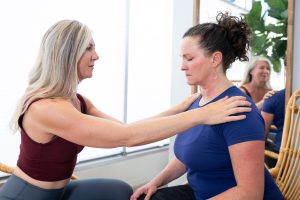
The irony of how I was feeling is that I had been teaching the importance of listening to your body for years, while not fully listening to my own. In my classes, I talked about being present, taking care of yourself, listening to your body, and creating awareness through yoga. Many years ago, I read The Body Keeps the Score by Bessel van der Kolk, and it opened the door to a deeper understanding of how our experiences live in the body. It led me down a path of somatic and embodied yoga and became part of the foundation for how I teach.
I understood these concepts well enough to teach them, but there was a disconnect between what I knew and how I was actually living. I did not fully understand the physiology underneath them or what it meant to truly embody these practices in my daily life.
And then, unexpectedly, I got the opportunity to experience this work in a completely different way. In August 2024, I was diagnosed with breast cancer, and my life abruptly shifted. I suddenly had no choice but to listen to what my body was saying. My diagnosis became the beginning of a much deeper journey. Since then, I have learned so much more about nervous system physiology, anatomy, stress, trauma, and what it really means to support the body. I am no longer simply teaching these ideas. Through my own lived experience, I have learned what supports my health and vitality, what does not, and what it means to truly embody these practices in everyday life.
One of the biggest things I have come to understand is that finding safety in my body is not only essential to heal from the disruption of cancer and treatment, but it has to be the foundation if we want to not only heal from past experiences and old wounds, but also to help our systems become more resilient to everyday stressors we can not escape. When the body feels safe, the nervous system can finally take an exhale, and our physiology can begin to move out of survival mode and into a state where rest, recovery, and repair are possible.
And what I have found is that to truly heal, you cannot outsource safety. At some point, you have to begin cultivating it internally. For me, that has meant going back to some very basic things that the body needs: getting enough sleep, getting outside in the morning and taking in natural light, allowing for rest and recovery alongside periods of activation, eating real food that nourishes. Moving my body, spending time in nature, and taking in less information. None of these things are complicated. And they all create the conditions for the body to have a chance to recover.
I recently read The Biology of Trauma by Dr. Aimie Apigian, and it connected so many dots for me. Through my own healing journey, I already understood how important managing stress is to our overall health. The book gave me a framework for understanding the deeper biology and physiology behind what I had been experiencing and the path I had been walking over the last couple of years. It helped me understand what was happening inside my body in a way that connected so many of the pieces I had already been learning, experiencing, and intuitively practicing.
Dr. Apigian describes the progression of the stress response from startle to activation, including fight or flight, to wall, freeze, and shutdown. The wall is what she calls the critical line of overwhelm. When stress becomes too much, lasts too long with no opportunity to rest and recover, or is not fully processed, the nervous system will move into the protective states of freeze and shutdown.
This information gave me the last few pieces of a puzzle I had been working on for years. I finally understand what had been happening in my own body from a deeper physiological perspecitive. At some point in my life, I had moved past my point of overwhelm and had been living on the shutdown side of the stress response for years. And when I look back at how I was living, it makes sense why I stayed there for so long.
Our culture does not exactly teach us that rest is productive. We are rewarded for accomplishing, carrying, producing, and pushing through. Rest becomes something we do when everything else is finished, and everything else is rarely finished. I had become very good at pushing through and was very disconnected from my interoception, my ability to notice and respond to the signals coming from within my body. Fatigue, tension, irritability, and depletion became things to work around rather than information to listen to.
I also began to see how my own patterns were perpetuating that state. By not stopping to rest and recover, I was continually asking my body to keep going without giving it the opportunity to replenish. The irritability, tiredness, tension, and sense of being overwhelmed were not just things happening to me. In many ways, the way I was living was helping to maintain them.
When the body is in shutdown, it is operating with very limited resources. So much energy is directed toward basic survival and conserving what is left that there is very little capacity for everything else. Looking back, I can see that my body was not working against me or failing me. It was responding to what I had experienced and doing what it knew to do to protect me.
For me, and for my own bioindividuality, I believe this prolonged state of shutdown was part of the internal terrain in which my cancer developed. Cancer is complicated and there are many factors involved. But understanding my physiology has made me understand that cancer can not live in an internal terrain that supports health, healing, and resilience. But it can find a home in one that is shaped by years of chronic stress, depletion, and survival.
It also helped me understand why coming out of shutdown is not necessarily as simple as creating safety and suddenly feeling calm. When the body has spent a long time in freeze or shutdown, the nervous system may need to move through activation before it can settle into a greater sense of safety and a ventral vagal state. This movement through activation is an important part of unwinding the stress response. If we expect ourselves to go directly from shutdown into calm, we can end up getting stuck in the process, wondering why we are still anxious, restless, angry, or overwhelmed when we are supposedly doing everything we can to feel safe.
As the nervous system begins to come out of shutdown, you may notice restlessness, anxiety, racing thoughts, anger, emotion, or a strong desire to move. You may become aware of sensations or feelings that you had been disconnected from. These experiences can feel uncomfortable, but they do not necessarily mean something is going wrong. Sometimes they are part of the process of the nervous system becoming more engaged and moving toward safety.
I experienced this long before I understood what was happening. I would sit down to rest and instead of feeling peaceful, my brain would start running. I would think about everything I needed to do. I would want to get up. I would feel restless and uncomfortable. My immediate response was, “I cannot possibly sit here. I need to get up. I need to keep going.” At the time, I thought I was simply bad at resting.
Now I understand that this was my nervous system learning how to move out of shutdown. And that understanding has given me more compassion for myself. Rather than forcing myself to relax, I now ask myself: What does my body actually need right now?
Sometimes the answer is rest. Sometimes it is movement. Sometimes it is getting outside, connecting with someone, slowing my breathing, or simply having some time when nobody needs anything from me. The goal is not to force my nervous system into calm. It is to learn how to listen, respond, and allow my system to move through the activation rather than getting stuck there, so that safety and regulation can become more accessible over time.
Over the last six months, I have also been paying much closer attention to my interoception, my ability to sense what is happening inside my body. I have began noticing the subtle signs that I am moving toward overwhelm rather than waiting until I am completely depleted. I pay attention to my breathing, tension, energy, thoughts, and the urge to keep going. Instead of automatically overriding those signals, I have began experimenting with small shifts in the moment.
We cannot always change the circumstances creating stress in our lives. We still have work, parenting, relationships, responsibilities, uncertainty, and all the things that make us human in our modern day world. The goal is not to eliminate stress. It is to become more aware of our own stress response so we can begin to make micro-shifts before we reach complete depletion.
I think of this as learning to ride a stress resiliency wave. We need activation. It helps us respond to life, solve problems, move, create, and get things done. But we also need recovery. We need to come back down, rest, repair, and replenish. The problem is that many of us have become very good at riding the activation side of the wave and not so good at completing the cycle.
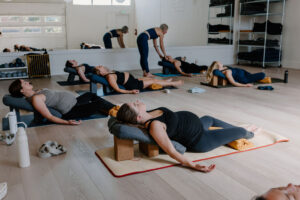
Rest does not have to wait until you can take a vacation once every four years. It can be much smaller. It can be morning sunlight, a walk outside, a few minutes away from the computer, a cup of tea without doing something else at the same time, eating when you are hungry instead of pushing through. Going to bed a little earlier and at a consistent time each night, or creating a little space between one task and the next. These small moments give the body another experience.
And this is where I think understanding physiology can be so empowering. Instead of immediately asking, “What is wrong with me?” we can become curious about what is happening inside us. Why am I so restless when I try to rest? Why am I holding my breath? Why do I feel depleted even though I have technically stopped? What might my body need right now?
That does not mean we can control everything about our bodies. We cannot. Not every symptom or condition can be explained by our habits or changed through lifestyle. But there are often small places where we can make a different choice.
There is a lot of compassion needed here. If you have spent years overriding your body’s signals, staying busy, or pushing through, you cannot simply decide one morning that you are going to become a completely regulated person. I often come back to one question: How long did it take me to get into this state? Probably a while. So why would I expect myself to get out of it overnight?
This is where one of the foundational principles of yoga, ahimsa, has become especially meaningful to me. Ahimsa is often translated as nonviolence, and I think about it as practicing nonviolence in the way we relate to ourselves. We can notice that our mind is racing without criticizing ourselves for not being able to relax. We can remind ourselves, “I am safe right now.” “I am doing the best I can.” “My body is trying to protect me.” “I do not have to figure everything out right now.”
How we speak to ourselves matters. If every pause comes with the message that we should be doing more, that we are behind, or that we should be handling everything better, then even rest can become another source of pressure. For me, the shift has been learning to notice what comes up when I stop. And then working fhard not to judge myself for my thoughts.
I also want to be clear that unwinding these patterns is not always something we can do on our own. Sometimes this work is long and deep. Depending on someone’s history and the duration and intensity of what they have experienced, there can be significant biological and physiological patterns that need support. Finding the right practitioner can be incredibly valuable. Somatic work, trauma informed therapy, body based practices, and other forms of support can help us understand what is happening and work with the body rather than continually trying to override it. There is no prize for doing this alone, and there is no timeline you need to follow.
For me, one of the most meaningful parts of this journey has been moving from the belief that something was wrong with me toward curiosity about what my body was communicating. I still get tired. I still get overwhelmed. I still move too quickly sometimes. I still catch myself doing five things at once or realizing that I have been holding my breath.
I cannot control every aspect of my physiology or eliminate stress, but I can make small choices that support my capacity to recover. I can rest instead of pushing through. I can move a meeting if I am feeling overwhelmed. I can move somatically when I feel stuck, step outside, put down the phone, or ask for support. These choices may seem small, but they add up.
That, for me, is where empowerment lives. Not in controlling my body or creating the perfect routine, but in understanding that the way I live matters. I have more influence than I realized over my internal terrain and how I want to feel in my body and my mind.
This is a process that builds on itself. As we make small shifts and experience that we can influence how we feel, we build self-efficacy and create new neural pathways. We can spend years feeling exhausted, overwhelmed, tense, or disconnected, believing we need to change something outside of ourselves, or just accept that how we feel is our new normal, or even turn to substances to numb the discomfort. When we do not understand what is happening inside of us, these can feel like our only options. But when we begin to understand our nervous system and develop somatic awareness, we can start to recognize what we need and begin to make small changes in how we move through our lives. And these micro-shifts can create more space, ease, and capacity within us. Over time, these small shifts become integrated into the way we move through our days, our weeks, and our lives. And what I have learned is that how we move through life shapes how we experience it.